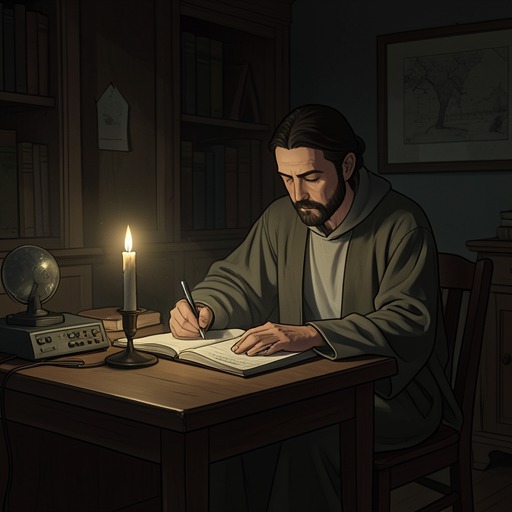
Do not add to or take away from the prophecy of Revelation
Book of RevelationDo not add to or take away from the prophecy of Revelation is the book’s closing prohibition against altering its prophetic words. Its two-sided warning attaches grave consequences to both addition and removal, making fidelity to the text a matter of more than interpretive preference.
The Closing Warning
Near the end of Revelation, the speaker testifies to everyone who hears the words of the prophecy: anyone who adds to them will have the plagues written in the book added to them. The paired clause turns the prohibition in the opposite direction as well: anyone who takes words away will have their part taken from the Book of Life, the holy city, and the things written in the book. Addition and subtraction are treated as corresponding violations, though the stated consequences differ.
The warning’s placement gives it a concluding force. It comes in the final sequence of the book, alongside the assurance that Jesus Christ is coming quickly and the closing appeal, “Even so, come, Lord Jesus.” The text therefore ends not only with an expectation of return, but with a boundary around the prophecy being awaited: its words are not to be enlarged or diminished.
Relation to the Author’s Reading of Revelation
The author argues that Revelation is not wholly chronological and that treating every passage as sequential has contributed to differing interpretations, including disagreement over the timing of the rapture. He reads the angelic interruptions in chapters 10 and 17 as returns to material that belongs elsewhere in the timeline, and he regards portions of chapters 11–14 as out of order. This is a proposal about how the book’s passages relate to one another; the closing warning itself states the ban on addition and removal, rather than setting out a rule about chronological arrangement.
That distinction matters in the author’s treatment of Mystery Babylon. He presents the identification of the figure with the United States as a possibility, not as an undisputed conclusion. His case draws on the descriptions of a power associated with many waters and peoples, a city that rules over kings, and a wealthy trading center whose destruction devastates merchants and seafarers. He also notes a difficulty: the text’s association of the city with the blood of prophets and saints leads him to wonder whether the United States might turn against Christians in the last days. These claims are interpretive applications of Revelation, distinct from the explicit closing prohibition.
Interpretive Stakes and Limits
The author’s overall approach puts two concerns beside one another: readers must attend to the sequence and structure of the visions, yet the prophecy must not be altered. His proposed rearrangement of passages is presented as a way of understanding their timing, not as permission to change their wording. Likewise, his discussion of the United States as a possible modern counterpart to Mystery Babylon remains expressly uncertain; the evidence offered is a set of perceived correspondences and a noted difficulty, not a claim that the identification is settled.
The rule thus supplies a clear limit while leaving questions of interpretation to be argued from the text. It names the consequences of adding or removing prophetic words; it does not, in the cited warning, decide the chronology of Revelation or resolve the identity of Mystery Babylon. Keeping those claims separate preserves the force of the closing prohibition without turning the author’s proposed readings into statements the passage itself does not make.